
Description
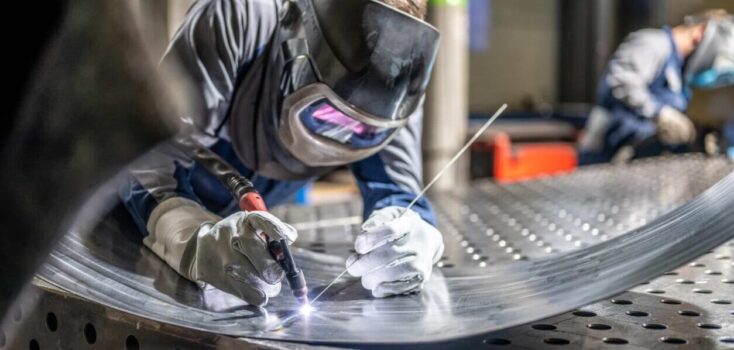
Welders operate welding equipment to weld ferrous and non-ferrous metals. This unit group also includes machine operators who operate previously set up production welding, brazing and soldering equipment. They are employed by companies that manufacture structural steel and platework, boilers, heavy machinery, aircraft and ships and other metal products, and by welding contractors and welding shops, or they may be self-employed.
Job Titles
- Aircraft welder
- Apprentice welder
- Blowtorch welder
- Solderer
- Torch welder
- Tungsten inert gas (TIG) welder
- Welder
- Welder apprentice
Main Duties
- Read and interpret blueprints or welding process specifications
- Operate manual or semi-automatic welding equipment to fuse metal segments using processes such as gas tungsten arc welding (GTAW), gas metal arc welding (GMAW), flux-cored arc welding (FCAW), plasma arc welding (PAW), shielded metal arc welding (SMAW), oxy-acetylene welding (OAW), resistance welding and submerged arc welding (SAW)
- Operate manual or semi-automatic flame-cutting equipment
- Operate brazing and soldering equipment
- Operate metal shaping machines such as brakes, shears and other metal straightening and bending machines
- Repair worn parts of metal products by welding on extra layers.
Workplaces
- Welding shops
- Welding contractors
- Self-employed
- Manufacturers of structural steel and platework, boilers, heavy machinery, aircraft, ships, and other metal products
Skills
- Equipment and Tool Selection
- Operation and Control
- Preventative Maintenance
- Quality Control Testing
- Reading Comprehension
- Coordinating
- Critical Thinking
- Decision Making
- Evaluation
- Instructing
Abilities
- Arm-Hand Steadiness
- Control of Settings
- Dynamic Strength
- Glare Tolerance
- Body Flexibility
- Depth Perception
- Far Vision
- Finger Dexterity
- Gross Body Coordination
- Gross Body Equilibrium
Personal Attributes
- Attention to Detail
- Independence
- Active Learning
- Adaptability
- Collaboration
- Concern for Others
- Stress Tolerance
- Analytical Thinking
- Creativity
- Innovativeness
Similar Occupations
- Weld tester (in 22230.00 Non-destructive testers and inspectors)
- Wave soldering machine operator (in 94201.01 Electronics assemblers and fabricators)
- Welder supervisor (in 72010.00 Contractors and supervisors, machining, metal forming, shaping and erecting trades and related occupations)
- Welding technologist (in 22101.02 Geological and mineral technicians)
Source: OaSIS
Employment Outlook
The employment outlook will be Good for welders and related machine operators (NOC 72106) in Prince Edward Island for the 2025-2027 period.
The following factors contributed to this outlook:
- Employment growth will lead to a moderate number of new positions.
- A moderate number of positions will become available due to retirements.
- There are a moderate number of unemployed workers with recent experience in this occupation.
Welders and related machine operators continue to face favourable job prospects in the province. Employment growth and retirements are expected to generate new positions, while ongoing industrial and construction activity sustains demand. Welders are employed primarily in manufacturing sectors such as metal fabrication, transportation equipment, and machinery production, with their work feeding into broader industrial and construction projects. The province’s economy remains well positioned, with manufacturing, exports, and construction identified as major growth drivers in 2025, which directly supports demand for welding skills. However, workforce shortages persist, with businesses having reported difficulty in filling skilled trades positions.
For new graduates or career seekers, this occupation offers stable employment opportunities, competitive wages, and pathways into specialized industrial sectors, though employers increasingly value candidates with formal training, certifications, and adaptability to diverse industrial settings.
Here are some key facts about Welders and related machine operators in Prince Edward Island:
- Approximately 550 people work in this occupation.
- Welders and related machine operators mainly work in the following sectors:
- Other services (except public administration) (NAICS 81): 43%
- Fabricated metal product manufacturing (NAICS 332): 19%
- Machinery manufacturing (NAICS 333): 13%
- Construction (NAICS 23): 11%
- Transportation equipment manufacturing (NAICS 336): 10%
- 66% of welders and related machine operators work all year, while 34% work only part of the year, compared to 59% and 41% respectively among all occupations. Those who worked only part of the year did so for an average of 44 weeks compared to 41 weeks for all occupations.
- 11% of welders and related machine operators are self-employed compared to an average of 13% for all occupations.
- The gender distribution of people in this occupation is:
- Men: 94% compared to 51% for all occupations
- Women: 6% compared to 49% for all occupations
- The educational attainment of workers in this occupation is:
- no high school diploma: 6% compared to 11% for all occupations
- high school diploma or equivalent: 21% compared to 28% for all occupations
- apprenticeship or trades certificate or diploma: 39% compared to 11% for all occupations
- college certificate or diploma or university certificate below bachelor’s: 31% compared to 25% for all occupations
- bachelor’s degree: less than 5% compared to 17% for all occupations
- university certificate, degree or diploma above bachelor level: less than 5% compared to 8% for all occupations
Source: Job Bank
Prevailing Wages
| AREA | LOW | MEDIAN | HIGH |
|---|---|---|---|
| PEI | $20.00 | $25.00 | $32.50 |
| Canada | $22.00 | $30.00 | $47.00 |
Training
| TRAINING PROGRAM | INSTITUTION | CREDENTIAL |
|---|---|---|
| Welding Fabrication | Holland College | Diploma |
| Welding Fabrication – Year 1 | Holland College | Certificate |
There are currently no job listings for this occupation on WorkPEI.